


How could my DLS polydispersity be zero? - WKB319051
ENVIRONMENT
- DYNAMICS™ software
ANSWER
A polydispersity value of zero in the DYNAMICS™ software can occur in both Cumulants and Regularization analyses. For Cumulants, 0% PD means the second cumulant could not be determined, often due to a nearly monodisperse sample or insufficient integration time. For Regularization, 0% PD indicates that the standard deviation of the radii distribution is approximately zero. The software also truncates negative PDI values to zero, because they are unphysical. Overall, a 0% PD suggests a monodisperse population at the detection limit of DLS.
ADDITIONAL INFORMATION
In the DYNAMICS™ software, each Dynamic Light Scattering (DLS) measurement reports polydispersity values for both Cumulants (assuming a monomodal sample) and Regularization (fitting a potentially multimodal sample) results. While in other guide articles we have described how these values are defined (see What is the definition of polydispersity in DYNAMICS? or Why is the %PD different from the Range %PD in DYNAMICS? for more information), here we will discuss how to interpret a polydispersity of zero in the DYNAMICS software.
As a reminder, for Cumulants %Polydispersity (Cumulants %PD), which is simply displayed as "%PD" in the DYNAMICS software, the calculation is in accordance with ISO 22413 (2017) and earlier:
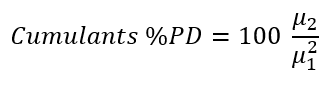
where µ1 is the first cumulant and µ2 is the second cumulant. In the DYNAMICS software, the Cumulants %PD is reported in the Datalog Grid as %PD, as shown below:

In contrast, for Regularization %Polydispersity, it is calculated as follows:
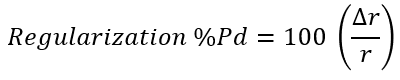
where the histogram peak width is used. Regularization polydispersity is calculated as the standard deviation of the radii distribution weighted, for example, to the %Intensity. And the regularization polydispersity index is calculated the same as Cumulants, %PD / 100. In this case, if the standard deviation of the histogram radii distribution is very wide, a range of %PD from 0 to 100%+ is possible, depending on the width of the histogram peak.
In the DYNAMICS software, the Regularization %PD is reported for each peak range as RangeX %Pd, as shown below:

%PD of Zero:
Following the definitions above, it is very possible to have a value of zero for %PD (for Cumulants or Regularization analysis).
When the DYNAMICS software reports 0 %PD for Cumulants analysis, it means that the second cumulant parameter could not be determined. Typically this happens when the sample is nearly monodisperse or when the integration time is not long enough to reduce the ACF noise to the level where it can determine the second cumulant.
Similarly, for Regularization %PD, when the DYNAMICS software reports 0 %PD, this means that the standard deviation of the radii distribution is approximately zero.
Additionally, negative values of the PDI are unphysical, so the DYNAMICS software truncates the value to 0 if the fit would be negative. Generally, 0 %PD indicates a monodisperse population, and this means that the PDI is at the limit of what can be distinguished by DLS.