


What is the definition of polydispersity in DYNAMICS? - WKB319096
ENVIRONMENT
- DYNAMICS software (version 6.10 and later, with enhancements in version 7.7 and 8)
- Dynamic Light Scattering (DLS) instrumentation
ANSWER
Polydispersity in DYNAMICS is assessed using either Cumulants or Regularization methods. Cumulants %PD is calculated per ISO 22413 (2017) using the first and second cumulants of the decay function, assuming a monomodal distribution. Regularization %PD is derived from the standard deviation of the histogram radii distribution, weighted by intensity. A %PD below 15% is considered monodisperse, while values above 30% indicate polydispersity. DYNAMICS 8 includes data-quality indicators to help assess the reliability of these measurements.
ADDITIONAL INFORMATION
Introduction
Polydispersity refers to the level of homogeneity of the sizes of the particles. When the level of homogeneity is high, the particles can be considered to be virtually identical in their size, or monodisperse. The level of homogeneity is considered high when the percent polydispersity is less than 15%. Polydispersity is caused by the presence of different species that cannot be resolved by the technique of dynamic light scattering (species with sizes differing by a factor of less than five cannot be resolved). A peak containing 100% monomer will have a smaller polydispersity than peak containing a mixture of monomer:octamer.
Dispersity vs. Polydispersity
It is important to differentiate the various definitions that may be found in literature or technical documentation. Dispersity (Đ) is defined by IUPAC as the degree of polymerization, and was formerly called the Polydispersity Index (PDI). It is the defined as Đ = Mw/Mn where we use weight-average and number-average molar mass. Static light scattering (at multiple angles for larger species) is a first-principle measurement of weight-average molar mass. For dynamic light scattering (DLS) analysis, we instead refer to either a Cumulants %Polydispersity or a Regularization %Polydispersity, where molar mass is not used but rather data streams from the DLS decay functions. You can refer to the DYNAMICS User's Guide and this related Guide Article, Why is the details.
Definitions for %PD, Polydispersity Index in DYNAMICS
For Cumulants %Polydispersity (Cumulants %PD), which is simply displayed as "%PD" in DYNAMICS, the calculation is in accordance with ISO 22413 (2017) and earlier.
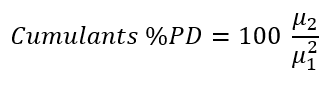
where µ1 is the first cumulant and µ1 is the second cumulant.
While every manufacturer uses the ISO definition for Cumulants %PD, how the cumulants is calculated may vary with manufacturer and algorithm. In general, the cumulant expansion assumes a mean decay rate (i.e., a monomodal size distribution) and computes moments of the distribution.

where

Please refer to the DYNAMICS User's Guide for more details regarding how Wyatt Technology calculates the first and second cumulants.
The Cumulants Polydispersity Index (PD Index) is given by %PD / 100. For DYNAMICS, the maximum for Cumulants is 57%. Above this value, DYNAMICS will report "Multimodal" as shown below for row 2.

In DYNAMICS, Cumulants-based data is reported as "Radius," "%PD," and "PD Index." For Regularization-based data, the Datalog Grid will bin the results in "Range X" where X is the defined by the Peak Range Settings by right-clicking on the Datalog Grid which DYNAMICS uses to bin multiple regularization peaks.
In the above example table, the Regularization radius and the Regularization %Pd is shown. The calculation of Regularization %Pd is different from Cumulants %PD. In this case, it is calculated as
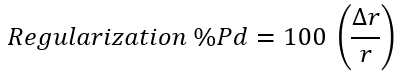
Where the histogram peak width. Regularization polydispersity is calculated as the standard deviation of the radii distribution weighted, for example, to the %Intensity. And the regularization polydispersity index is calculated the same as Cumulants, %PD / 100. In this case, if the standard deviation of the histogram radii distribution is very wide, a range of %PD from 0 to 100%+ is possible, depending on the width of the histogram peak.
Conclusion
In general, a %PD less than 15% is considered monodisperse, whereas a value between 15 - 30% is somewhat monodisperse but may depend on the nature of the sample and quality of the ACF. A %PD above 30% can be considered polydisperse. While these values can give some insight, it is critical to assess the quality of the ACF before reporting data from DYNAMICS. DYNAMICS 8 features data quality indicators for assessing the suitability of the data for reporting. Please also refer to TN2008 Interpreting Autocorrelation Functions in DYNAMICS, TN2009 Utilizing Data Filters in DYNAMICS, TN2004 Hydrodynamic Radii Distributions, and TN2005 Cumulants versus Regularization Analysis for more information.
Appendix: Notes Regarding Previous Versions of DYNAMICS
The above definitions of Cumulants %PD and PDI have been implemented in DYNAMICS since version 6.10. Improvements to the second cumulant calculations were implemented in DYNAMICS 7.7, which may result in %PD being different in versions earlier than DYNAMICS 7.7 but can be recalculated in newer versions by opening the data file in a later version of DYNAMICS and recalculating to update the datalog grid. In DYNAMICS 7.7, we also made the Regularization PD Index consistent with Cumulants PD Index, i.e., %PD / 100.